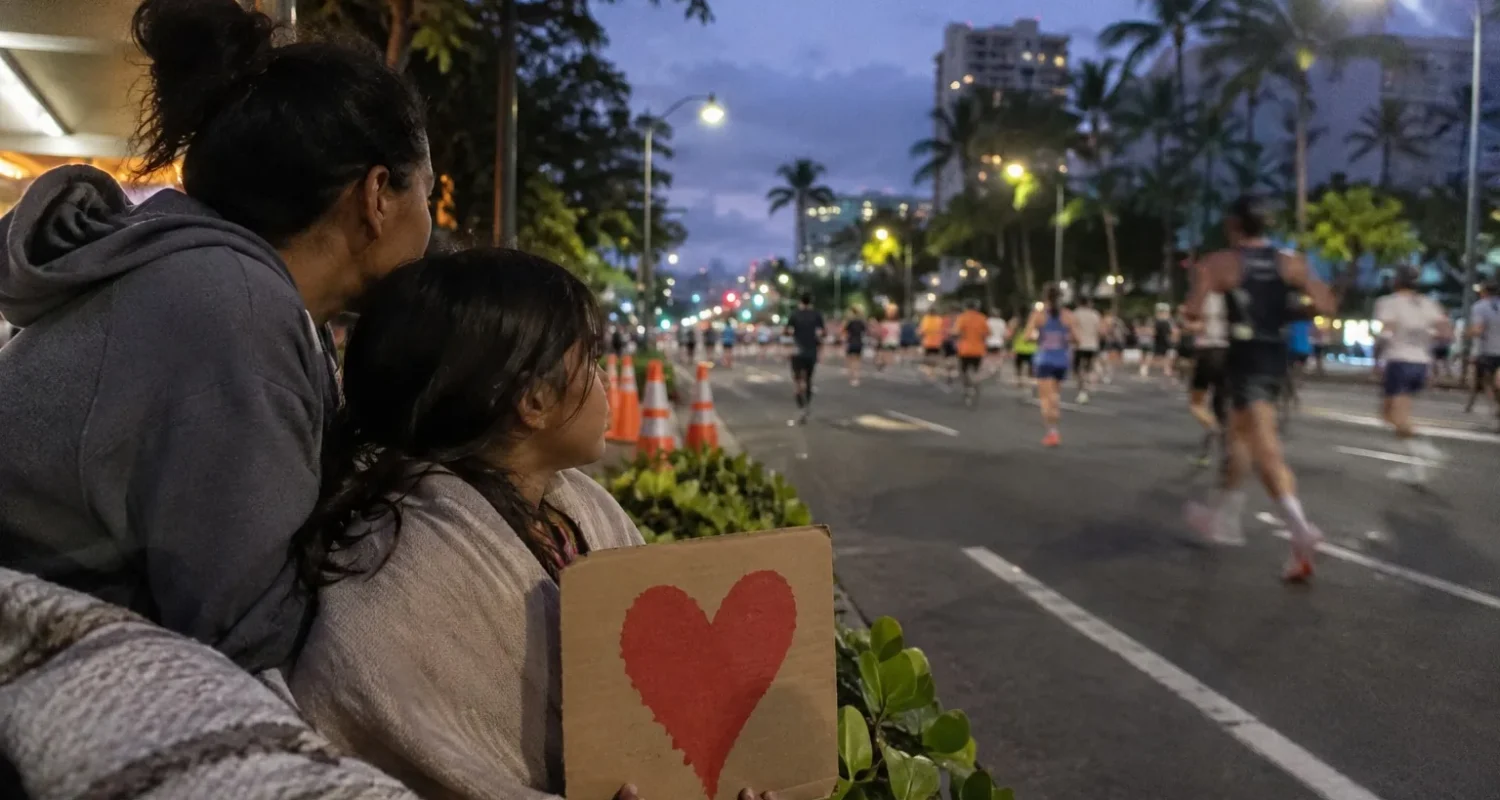
The places you can realistically watch the Honolulu Marathon on Sunday, December 13, 2026, are the ones you can walk to from Waikiki: Kalākaua Avenue early in the race, Diamond Head Road (runners pass it twice), and the finish in Kapiʻolani Park near the Bandstand. Roads start closing from 12:30 a.m. and there’s no official parking, so plan to go on foot. Track your runner live by bib number, and agree on a meeting spot away from the finish before race day.
Here’s how to plan a cheering morning that works with the course, the closures and the dark.
Where can you watch the Honolulu Marathon from Waikiki on foot?
Start with the shape of the course, because it decides everything. The marathon starts at 5:00 a.m. on Ala Moana Boulevard near Ala Moana Beach Park and heads west toward downtown. It loops through downtown past Aloha Tower, ʻIolani Palace and the Honolulu Hale Christmas lights, comes back east along Ala Moana Boulevard past Ala Moana Center and the Hilton Hawaiian Village, then turns onto Kalākaua Avenue and runs right through Waikiki.
From there it goes around Kapiʻolani Park, climbs Diamond Head Road, and heads out east on Kalanianaʻole Highway to Hawaiʻi Kai. Runners turn there and come back through Kāhala, return along the ocean side of Diamond Head Road past the Diamond Head Lighthouse, and finish in Kapiʻolani Park. For every turn, see our Honolulu Marathon course guide.
For a supporter staying in Waikiki, that’s good news. The race comes to you twice: once early, through the middle of Waikiki, and once at the end, around Diamond Head and into the park. The long middle section out to Hawaiʻi Kai is the part you can’t easily reach.
| Viewing area | When runners pass | On foot from Waikiki? | Worth knowing |
|---|---|---|---|
| Start, Ala Moana Boulevard near Ala Moana Beach Park | 5:00 to 5:30 a.m. (everyone must cross the start by 5:30) | Yes from the ʻewa (west) end of Waikiki; a long walk from the Diamond Head end | Fireworks open the race. Very crowded, and your runner passes in seconds |
| Ala Moana Boulevard by Ala Moana Center and Hilton Hawaiian Village | After the downtown loop, in the dark | Yes, from the ʻewa end | Last year this stretch was detoured from 12:30 a.m., reopening about 8:00 a.m. |
| Kalākaua Avenue through Waikiki | Inside the first 10 km, mostly before sunrise | Yes, it’s the main street | Last year traffic was moved onto Kūhiō Avenue from 3:30 a.m. |
| Diamond Head Road | Twice: the climb on the way out, and the ocean side on the way back | Yes, from the Kapiʻolani Park end of Waikiki | Police control the road until runner numbers thin |
| Finish, Kapiʻolani Park near the Bandstand | From the leaders, just over two hours in, until the last walker | Yes | There’s no time limit, so the finish stays open until the last participant crosses |
| Downtown, King Street and Honolulu Hale | Early, in full dark | Not really; it’s a long pre-dawn walk | Fun with the lights, but hard to reach with roads closed |
| Kalanianaʻole Highway and Hawaiʻi Kai | The middle miles | No | Closed to through traffic last year, and some TheBus routes were cancelled or detoured |
How do we know the Waikiki stretch comes inside the first 10 km? The Start to Park 10K uses the first 10 km of the same course and finishes in Kapiʻolani Park, so the marathon field has passed through Waikiki by about that point.
Watching the start
The start is the big spectacle: fireworks, music and tens of thousands of people (organizers say “over 35,000 runners”) moving off Ala Moana Boulevard in the dark. If you’re staying near the Hilton Hawaiian Village or the ʻewa end of Waikiki, it’s a reasonable walk. The trade-off is that you’re up very early, the area is packed, and you’ll see your runner for a second at best, if at all. Many supporters skip the start and save their energy for later.
Kalākaua Avenue in the dark
Kalākaua is the easiest early spot for most Waikiki hotels. Runners come through before sunrise for most of the field (sunrise on December 13 is about 7:00 a.m.), so it’s lively, cheerful and a little surreal: a city street full of runners under the streetlights. Stand on the side of the road closest to your hotel. Crossing the course may be restricted, and you don’t want to get stuck on the wrong side.
Diamond Head Road and the last miles
Diamond Head Road is the climb around the crater, and runners use it twice. On the way out it’s the first real hill. On the way back, they run the ocean side past the lighthouse, close to the end of the race. That return leg is where a familiar face helps most. It’s walkable from the Diamond Head end of Waikiki, though it’s uphill from the park, so wear proper shoes.
The finish in Kapiʻolani Park
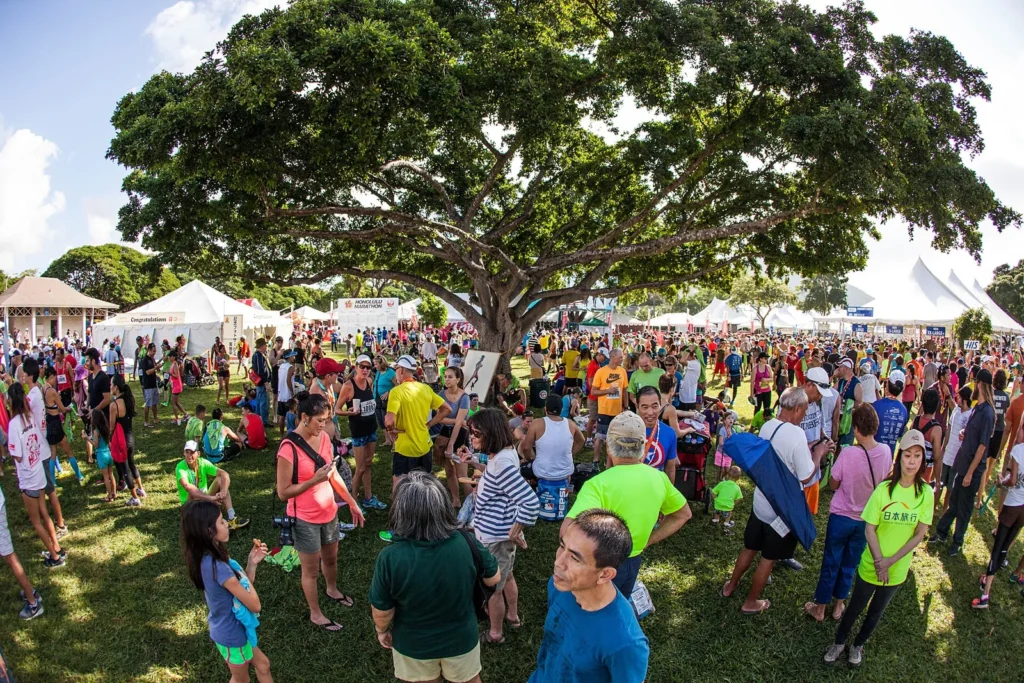
The finish is near the Kapiʻolani Park Bandstand, at the Diamond Head end of Waikiki. The leaders arrive just over two hours after the start (the men’s course record is 2:07:59), and finishers keep coming all morning and beyond, because there’s no time limit. If you only make one stop, this is the one, but read the meeting section below before you choose your exact spot.
Can you see your runner more than once?
Yes, usually twice, without needing transport. A simple plan for a supporter staying in Waikiki:
- Catch them on Kalākaua Avenue in the dark, early in the race.
- Go back to your hotel or find breakfast. The middle of the race, out to Hawaiʻi Kai and back, takes most of the morning, and you can’t get there easily anyway.
- Use live tracking to judge when they’re heading back toward Diamond Head.
- Choose one: the ocean side of Diamond Head Road, or the finish. Your runner will cover the last stretch faster than you can walk it, so trying to do both usually means missing one.
Some supporters try to see the Kalākaua pass and then the outbound climb on Diamond Head Road too. It’s a short distance on a map, but you’d be moving through crowds in the dark, so treat a second early sighting as a bonus rather than the plan.
Tell your runner where you’ll stand: which side of the road, and near what. Then they’ll be looking for you instead of hoping.
How do you track a runner live on race day?
The race offers live tracking by bib number on race day (it’s called “Track My Run” on the official site). Your runner’s bib number arrives by email during race week, so ask them to forward it to you, and write it down somewhere other than your phone.
A few things to expect:
- Updates aren’t continuous. Chip-timing systems record runners as they cross timing points, so there can be a long gap between updates, especially on the out-and-back to Hawaiʻi Kai.
- Chip time includes breaks. It’s total elapsed time from when they crossed the start, so a bathroom stop or a walk through an aid station shows up. Their own GPS watch may differ slightly.
- Preliminary results go online on race day. Official results follow from Finisher Monday, December 14.
- Phone signal can be slow in big crowds. Charge your phone fully and carry a small battery pack.
How do you meet your runner after the finish?
This is where most race-day plans fall apart, so decide it before Sunday.
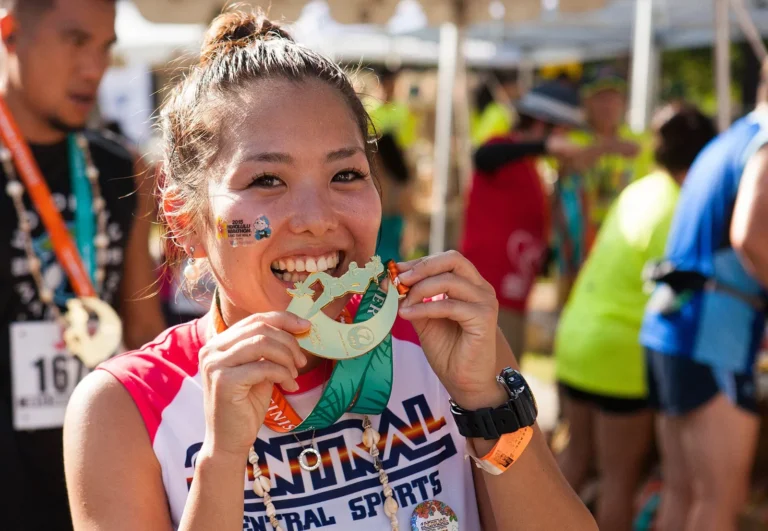
When runners cross the line, they walk through the finisher area for their medal, their finisher shirt (handed out after they finish), malasadas, bananas, water and recovery drinks. Expect that area to be for participants, and check race-week information for where supporters can wait. Your runner will be tired, slow and possibly a bit foggy, so make it easy for them.
- Pick a fixed landmark outside the finish area. Something specific you’ll both recognize, not “the park”. Kapiʻolani Park is big, and the area near the Bandstand will be the busiest part.
- Agree on a backup time. If you haven’t found each other by then, you both go to the backup spot, or back to the hotel. Phones may not cooperate.
- Send a photo of the spot to your runner the day before, so they know exactly what to look for.
Carry their post-race bag
There’s no gear check at the start or along the course. There is a clothing-only check-in tent at Kapiʻolani Park, and only the official bag from packet pickup is accepted; unclaimed bags after 3:00 p.m. on race day are donated. Check the official FAQ for the tent’s hours.
That makes a supporter with a bag very welcome at the finish. Good things to bring for your runner:
- A dry shirt and a light layer
- Rubber slippers or comfortable shoes
- A small towel
- Their phone, if they didn’t run with it
- Something they like to eat or drink after a long effort
What should spectators bring?
You’ll be out from the dark into full sun. The official FAQ describes race mornings as often in the mid-60s °F (18 to 20 °C), rising to the low 80s °F (27 to 28 °C) by mid-morning, humid and sunny. Our race weather guide has more on what to expect.
- A small light for walking to Kalākaua before dawn
- Water and a snack, because you’ll be up for hours
- Sunscreen, a hat and sunglasses for after 7:00 a.m.
- A light layer for the early start
- Your runner’s bib number, written down
- A charged phone and battery pack
- A sign or something bright so your runner can spot you; a balloon or a colored hat is easier to see from the road than a face in a crowd
If you plan to hand your runner anything, agree on it in advance and step back off the course straight away. There are 16 official aid stations with water, sports drinks and medical help, so they won’t go short. Stay behind any barriers, follow police and volunteers, and keep children close to you near the road.
How do road closures affect spectators?
A lot. The 2026 Traffic Advisory isn’t published yet, but last year’s gives a good idea. Lanes started closing from 12:30 a.m., tow-away zones ran from midnight to 5:00 p.m., Kalākaua traffic moved to Kūhiō Avenue from 3:30 a.m., and Kalākaua between Monsarrat Avenue and Poni Moi Road stayed restricted until the marathon was over. Monsarrat Avenue was closed from 4:30 a.m. to 3:00 p.m. Some TheBus routes were cancelled or detoured.
There’s no official parking at the start or finish, and organizers recommend walking from Waikiki. The free shuttles from the Honolulu Zoo to the start (2:00 to 4:00 a.m.) are there to get runners to the start line. For the full picture, read our Honolulu Marathon road closures guide, and if you’re still choosing a hotel, our guide to where to stay for the marathon explains why walking distance matters so much on race morning.
Getting home after the finish works the same way: on foot. Rideshares will struggle to reach the park while the roads are closed, so expect to walk back to your hotel.
What can supporters do on the days around the race?
Race day itself is about the runner. The days before it can be about you.
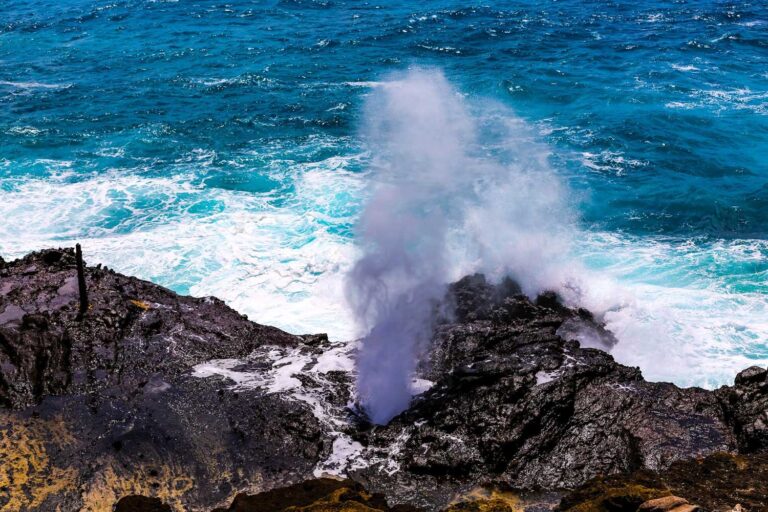
If you’ve come to support someone, Thursday 10 to Saturday 12 December are good days to see the rest of Oahu while your runner rests, picks up their packet and keeps their legs fresh. Our full-day circle island tour picks up from six fixed points in Waikiki between 6:50 and 7:15 a.m. and takes about 9.5 hours, with stops including the Diamond Head Lookout, Hālona Blowhole, Leonard’s Bakery, Mokoliʻi, Tanaka’s Kahuku Shrimp, Turtle Beach and the Dole Plantation.
Supporters, see the island while your runner rests. Thursday 10 to Saturday 12 December are good days for a full circle island loop, with the Standard tour at $59 per person. Check dates and book the tour
One fun detail: the tour’s first stop, the Diamond Head Lookout, is on Diamond Head Road, the same road the marathon climbs. You’ll see the hill before your runner does.
Please don’t plan the tour for Sunday, December 13. Roads on our route are closed that morning, including Kalākaua, Diamond Head Road and Kalanianaʻole Highway. If you’re thinking about that day at all, call us first on (808) 294-9906. For runners, Monday, December 14 onward is the time for a sit-down day around the island. See the full-day tour page for the stops and timings.
Good to know (checked November 2026)
The 2026 Traffic Advisory hasn’t been published; closure times above are from the 2025 advisory. Live tracking by bib number runs on race day, with official results from Finisher Monday, December 14. The clothing-only check-in tent’s hours are listed inconsistently, so confirm them in the official FAQ. Sources: JAL Honolulu Marathon event page, official FAQs, 2025 Traffic Advisory. Race-day traffic line: (808) 221-9534.
FAQ
Where can you watch the Honolulu Marathon from Waikiki?
On foot, the practical places are Kalākaua Avenue through Waikiki early in the race, Diamond Head Road (passed on the way out and again near the end), and the finish in Kapiʻolani Park near the Bandstand. The middle of the course, out to Hawaiʻi Kai, is hard to reach.
What time do runners pass through Waikiki?
Most runners come along Kalākaua Avenue early, inside the first 10 km and mostly before sunrise at about 7:00 a.m. Use live tracking by bib number to time it for your runner.
Can spectators watch the start?
Yes. The start is on Ala Moana Boulevard near Ala Moana Beach Park at 5:00 a.m., with fireworks. It’s walkable from the ʻewa end of Waikiki, but it’s crowded and dark, and you may not spot your runner.
How do I track a runner in the Honolulu Marathon?
Use the official live tracking (“Track My Run”) with your runner’s bib number. The bib number is emailed to runners during race week, so ask them to send it to you.
Is there parking near the Honolulu Marathon finish?
No official parking is provided at the start or finish, and many roads are closed on race morning. Organizers recommend walking from Waikiki.
Where should I meet my runner after the finish?
Agree on a specific landmark outside the finish area before race day, plus a backup time in case phones don’t work. Bring their dry clothes, since there’s no gear check at the start.
Cheer loud, then plan your island day
Spectating the Honolulu Marathon is mostly about timing and walking: Kalākaua in the dark, a long breakfast, then Diamond Head Road or the finish when the tracker says it’s time. Get the meeting spot sorted, carry the dry clothes, and you’ll be the most popular person in Kapiʻolani Park. For the rest of race week, our Honolulu Marathon 2026 visitor guide brings every part of the trip together.
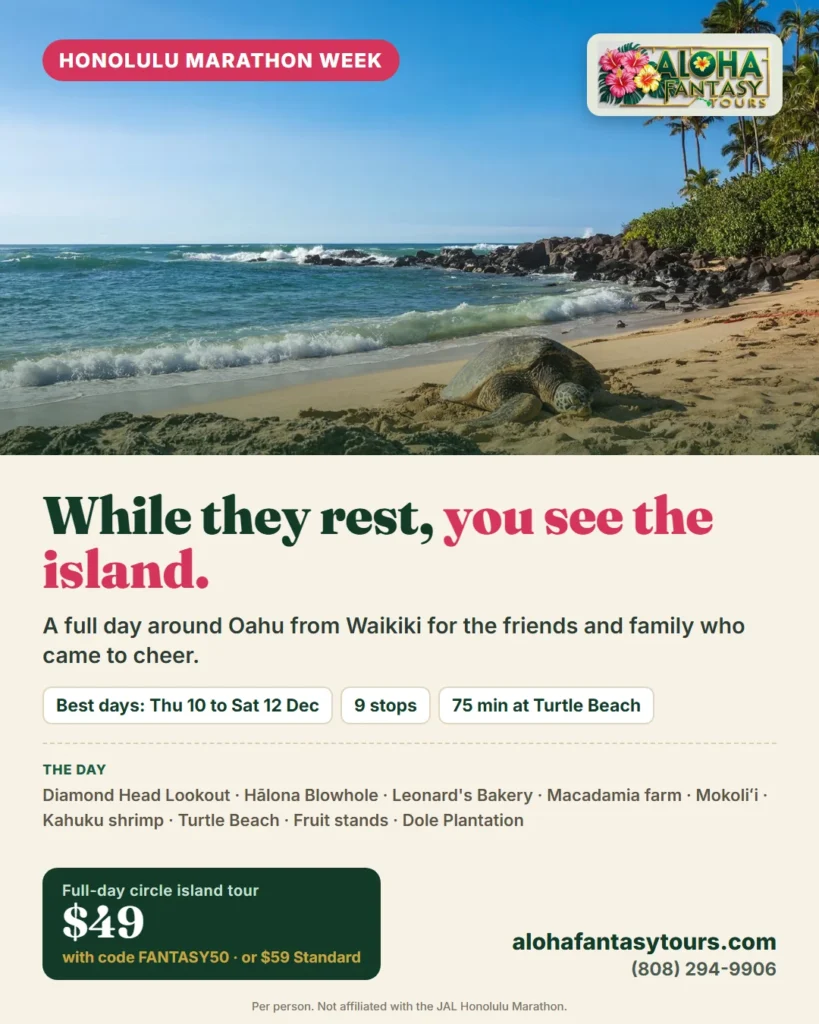
Make one day of race week about the island. Supporters can tour Thursday 10 to Saturday 12 December, and runners from Monday 14 December, with pickup from six Waikiki points between 6:50 and 7:15 a.m. Check dates and book the tour
Aloha Fantasy Tours has run circle island tours on Oahu since 2010. We are not affiliated with the JAL Honolulu Marathon.
Photo credits: Anthony Quintano from Honolulu, HI, United States, CC BY 2.0. Race photos are from past Honolulu Marathons.