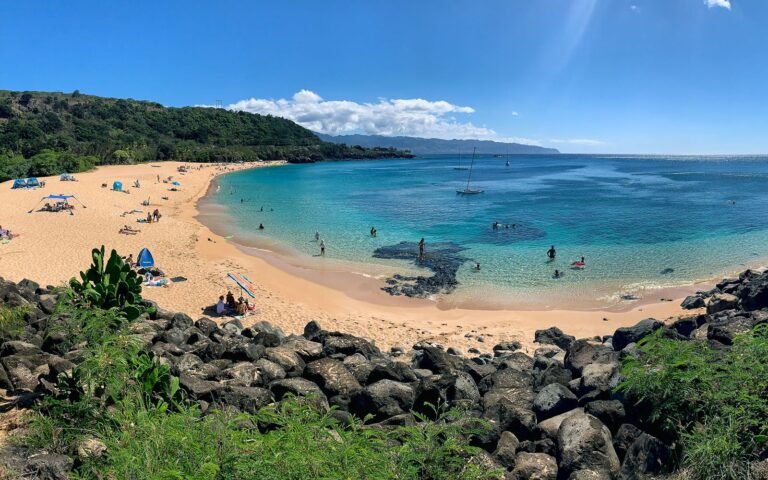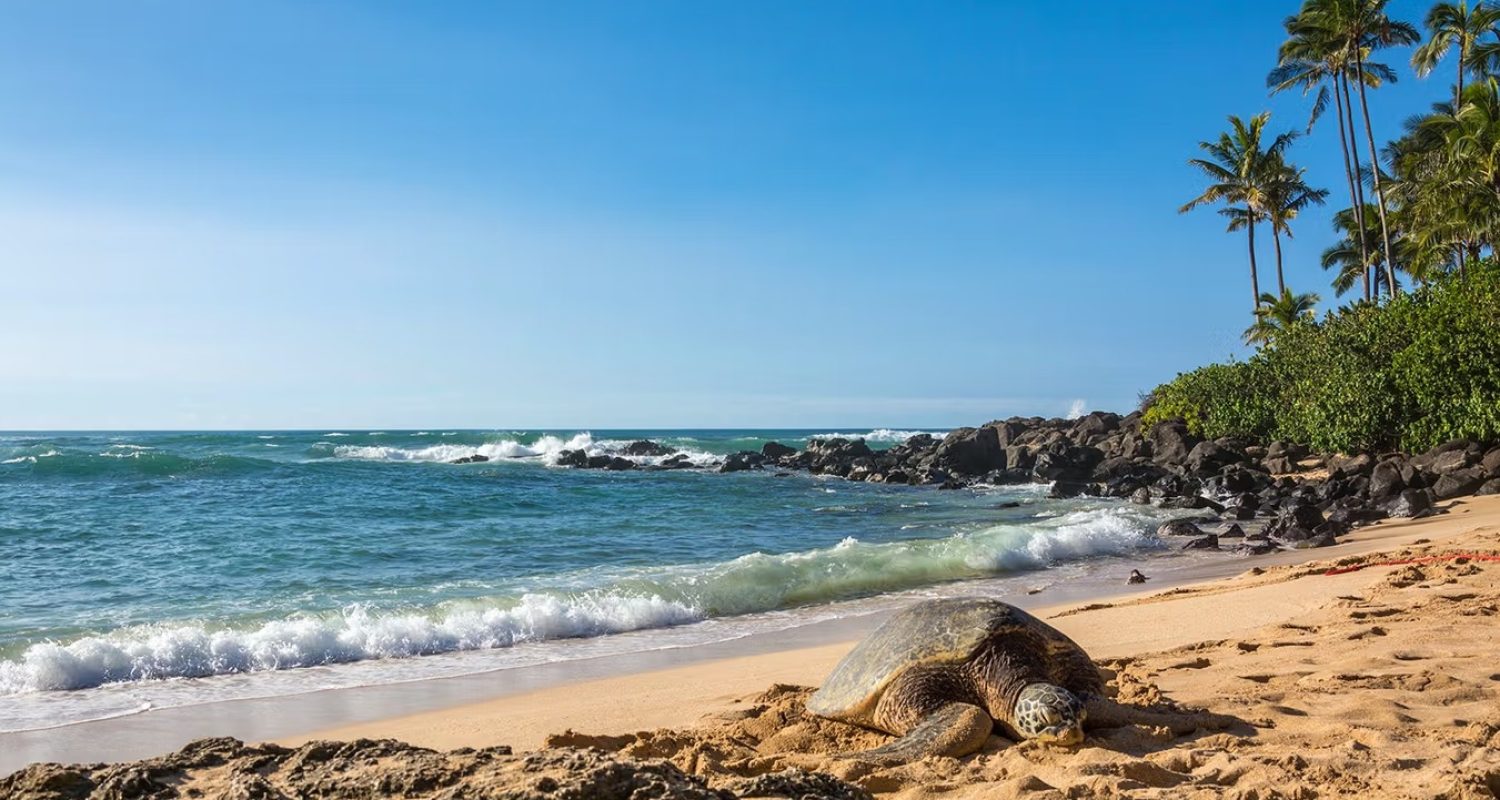
“Turtle Beach” is the common name for Laniakea Beach on Oahu’s North Shore, between Haleiwa and Waimea Bay, where Hawaiian green sea turtles often come ashore to rest. It’s the most reliable place on Oahu to see a turtle from the sand. Turtles also appear in calmer water around the island, but no sighting is ever guaranteed, and wherever you see one, you need to stay at least 10 feet away.
Here’s where to go, when to go, and how to enjoy the honu without disturbing them.
Where is Turtle Beach on Oahu?
Laniakea sits beside Kamehameha Highway on the North Shore, a few minutes east of Haleiwa town and before Waimea Bay. It’s roughly an hour’s drive from Waikiki without traffic.
It isn’t a classic swimming beach. The shoreline is rocky in places and the reef is shallow. People come here for one reason: the Hawaiian green sea turtles, or honu, that feed on the algae along the reef and often haul themselves onto the sand to rest.
A word on traffic and parking. Laniakea is right beside a busy two-lane highway, and parking is limited. Park only in legal spots, never stop in the road, and take real care crossing the highway.
Why do turtles come up on the beach?
Hawaiian green sea turtles are one of the few sea turtle populations in the world that regularly bask on land. They come ashore to rest, and possibly to warm up and to get away from sharks in the water.
A basking turtle can look lifeless. It isn’t. It’s resting, and it needs to be left alone. Sand on its shell and slow breathing are normal.
Other places to see turtles on Oahu
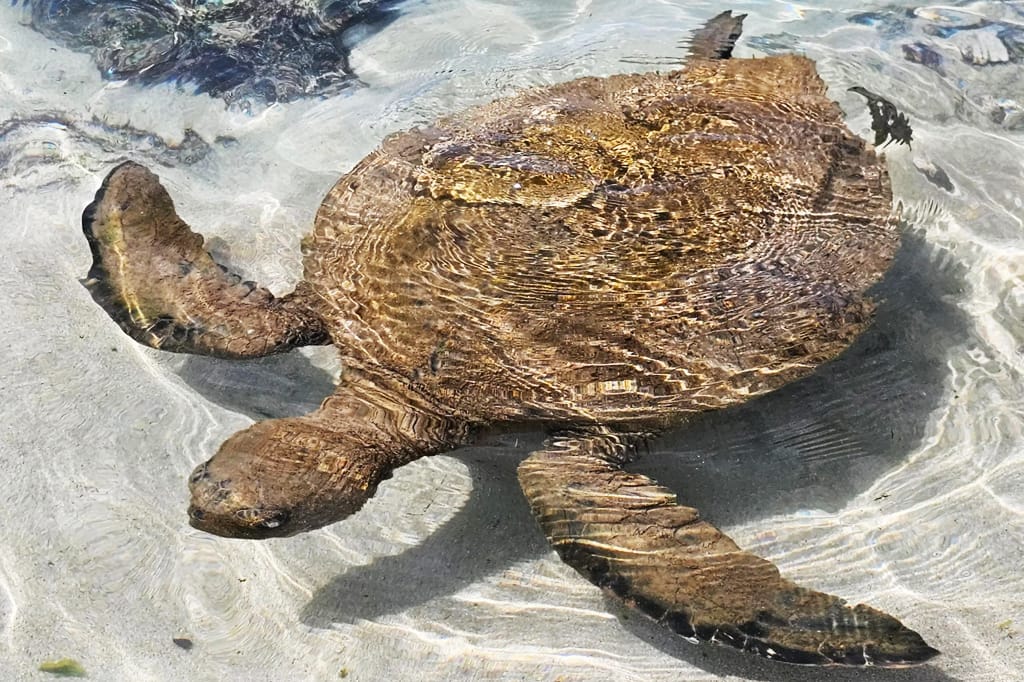
Honu live in coastal waters all around the island, so Turtle Beach isn’t the only chance. Sightings elsewhere depend more on luck, water clarity and conditions:
- Other North Shore beaches. Turtles feed along the reefs of the North Shore, and in calm summer conditions, swimmers and snorkelers sometimes see them in the water.
- Hanauma Bay. The protected bay is known mainly for its reef fish, but turtles do pass through. It needs a reservation made two days ahead.
- The south shore around Waikiki. Turtles are sometimes seen off Waikiki’s reefs, particularly by surfers and snorkelers.
- Snorkel and boat tours. Licensed operators visit spots where turtles are commonly seen. Choose one that follows the viewing rules and never promises you can touch or swim with a turtle.
When is the best time to see turtles?
During daylight. Turtles don’t keep a timetable, so you might see several on one visit and none on the next. Mornings are usually cooler and quieter. An afternoon visit can be just as good.
For snorkeling, choose your day by ocean conditions rather than the clock. North Shore water is often calm in summer and can be dangerous in winter, when big surf arrives. Check the conditions and ask a lifeguard before going in.
The rules: how to watch turtles responsibly
These rules protect the turtles, and they keep you on the right side of the law.
- Stay at least 10 feet away, on the sand and in the water. That’s NOAA Fisheries’ guidance for sea turtles, and 10 feet is about the length of a longboard surfboard.
- Never touch, chase, ride or feed a turtle. Feeding changes their natural behavior. Touching and harassing them is against the law.
- Don’t block a turtle’s path to the ocean. Leave a clear route between a resting turtle and the water.
- Don’t crowd. If other people are already too close, step back rather than joining them.
- Stay behind ropes and signs. Volunteers often mark out a viewing area around a resting turtle. Follow their lead, even if the turtle seems far away.
- If a turtle swims toward you, move away calmly. The 10-foot rule applies even when the turtle comes to you.
- Never put anything on a turtle, and never try to move one back into the water.
Are Hawaiian green sea turtles endangered?
The Hawaiian population of green sea turtles is listed as threatened under the US Endangered Species Act, and it’s protected by both federal and state law. Protection is why the population has recovered as much as it has, and why honu are so visible on Oahu today.
Honu in Hawaiian culture
The honu has a special place in Hawaiian culture. For some Native Hawaiian families, the honu is an ʻaumakua, a family guardian spirit passed down through generations. Turtles appear in ancient petroglyphs carved into lava rock, and in stories told across the islands.
Many people in Hawaii see the honu as a symbol of long life, endurance and safe navigation. Watching one quietly, from a respectful distance, is the best way to honor that.
Photographing turtles without breaking the rules
- Use your zoom, not your feet. A phone’s 2x or 3x zoom is usually enough from 10 feet.
- Shoot low, from where you’re standing. Crouching gives a better angle than leaning in.
- Be patient. Turtles move slowly. Wait for one to lift its head or shift toward the water.
- Never use a selfie as an excuse to get closer. If the photo needs you to be within 10 feet, skip the photo.
Seeing Turtle Beach on a tour
If you’d rather not drive to the North Shore and hunt for parking, our full-day circle island tour spends 1 hour and 15 minutes at Turtle Beach, the longest stop of the day. There’s time to watch the turtles, walk the beach and, when conditions allow, get in the water. Free snorkel gear is included on the $59 Standard tour.
Watch the honu without the drive. The $59 Standard tour includes 75 minutes at Turtle Beach, free snorkel gear and a free malasada at Leonard’s. Pickup is from six points in Waikiki between 6:50 and 7:15 a.m. Check dates and book
For the rest of the day, see the complete circle island tour route, and what to pack for a full day tour.
Good to know (checked September 2026)
NOAA Fisheries recommends staying at least 10 feet (3 meters) from sea turtles, on land and in the water. Read more on NOAA’s green turtle page. Parking and road layouts near Laniakea can change, so follow posted signs on the day.
FAQ
Where is Turtle Beach on Oahu?
Turtle Beach is the common name for Laniakea Beach, on the North Shore between Haleiwa and Waimea Bay, beside Kamehameha Highway. It’s about an hour’s drive from Waikiki without traffic.
Can you swim with turtles on Oahu?
You may see turtles while swimming or snorkeling, but you shouldn’t approach, follow or touch them. Stay at least 10 feet away in the water. If a turtle swims toward you, move away calmly.
Can you touch sea turtles in Hawaii?
No. Hawaiian green sea turtles are protected under federal and state law, and touching or harassing them is illegal. Stay at least 10 feet away.
What time of day are turtles at Turtle Beach?
There’s no fixed schedule. Turtles come and go through the day, so a sighting is never guaranteed. Daylight visits give you the best chance, and mornings are usually quieter.
Is Turtle Beach free to visit?
Yes. It’s a public beach with no entry fee. Parking is limited, so use legal spots only and take care near the highway.
See the honu the right way
Go in daylight, keep 10 feet back, and let the turtles stay wild. Whether you see one honu or five, it’s one of the most memorable things you can do on Oahu.
Make Turtle Beach part of your island day. Book the $59 Standard full-day tour, or see the $49 Promo Full-Day Loop and current offers.
Aloha Fantasy Tours has run circle island tours on Oahu since 2010.