Yes, you can walk the whole Honolulu Marathon. There’s no time limit: the finish stays open until the last participant crosses, and walkers get the same medal and official time as runners. The one deadline is at the start, where everyone must cross the line by 5:30 a.m. on Sunday 13 December 2026. Plan for a long morning in rising heat, because the sun comes up at about 7:00 a.m. and temperatures reach the low 80s °F by mid-morning.
New to the race altogether? Start with our Honolulu Marathon first-timers guide for the overall shape of the day. This guide is just for walkers and run-walkers.
What does “no time limit” actually mean?
It means exactly what it says on the finish line, with a few practical edges worth knowing.
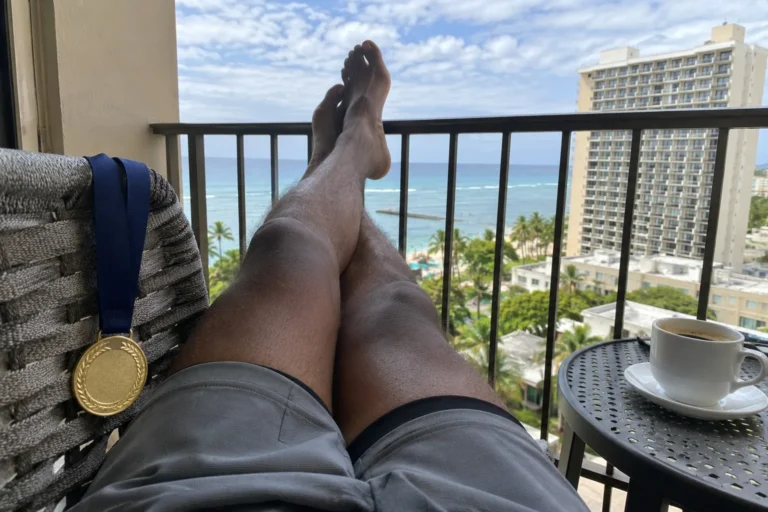
What it guarantees. The official event page says the finish stays open until the last participant crosses, and walkers receive a medal and an official time. There’s no finish cutoff, so you won’t be asked to leave the course for being slow. You won’t be listed as a non-finisher because you took eight or nine hours.
What it doesn’t change. You still have to cross the start line by 5:30 a.m. And your chip time is total elapsed time, including any breaks, so a sit-down at an aid station or a queue at a restroom counts toward your official time. Your GPS watch may show something slightly different.
What happens around you. The city gives roads back as the field thins out. In last year’s traffic advisory, police controlled Diamond Head Road, Kāhala Avenue and Kealaʻolu Avenue until runner numbers thinned, with Kāhala-area access returning at about 11:30 a.m., delays on Kīlauea Avenue until about 11:00 a.m., and contra-flow traffic on Kalākaua Avenue from about 9:00 a.m. The 2026 advisory hasn’t been published yet, but expect a similar pattern: the farther back you are, the more the streets around you start to look like ordinary streets again. Stay where course marshals and police direct you, and keep your awareness up if you’re wearing headphones.
None of that is a reason to worry. It’s simply the reality of a race with no cutoff in a working city.
How long does it take to walk the Honolulu Marathon?
That depends entirely on your pace and your breaks. Here’s the plain arithmetic for 26.2 miles at a steady pace with no stops, assuming you cross the start line at about 5:20 a.m.
| Pace per mile | Pace per km | Moving time | Finish clock time (no breaks) | Miles done by sunrise, about 7:00 a.m. |
|---|---|---|---|---|
| 13 min | 8:05 | 5 h 41 min | about 11:00 a.m. | about 7.7 |
| 15 min | 9:19 | 6 h 33 min | about 11:55 a.m. | about 6.7 |
| 17 min | 10:34 | 7 h 25 min | about 12:45 p.m. | about 5.9 |
| 20 min | 12:26 | 8 h 44 min | about 2:05 p.m. | about 5.0 |
| 22 min | 13:40 | 9 h 36 min | about 2:55 p.m. | about 4.5 |
Two things jump out of that table.
First, most walkers will be on the course well past noon. Add restroom stops, a few minutes at the aid stations and a slower stretch on the hills, and the finish clock moves later again.
Second, most walkers see sunrise in the first third of the race. The Start to Park 10K, which uses the first 10 km (6.2 miles) of the same course, finishes in Kapiʻolani Park. So at a typical walking pace, the sky lightens somewhere between Ala Moana and the Waikiki end of the course, before the climb around Diamond Head. Everything after that is in daylight.

Where should walkers line up at the start?
You don’t pick your spot on the morning. Your start color is printed on your bib, and it’s based on the predicted finish time you gave at registration. Walkers and slower run-walkers will generally be toward the back, which is where you want to be: you won’t be swept along by faster runners, and the crowd moves at a pace that suits you.
A few things to know about that back-of-the-pack start:
- It can take a while to reach the line. The gun goes at 5:00 a.m., and everyone must cross by 5:30 a.m. Your chip time starts when you cross, not when the fireworks go off.
- Official pacers run from 3 hours to 5 hours. That range is aimed at runners, so most walkers will be pacing themselves.
- Restrooms come first. Portable restrooms are at the start, along the course and at the finish. Use one before you join your corral rather than leaving it to the last minute.
How do you pace a walk or run-walk over 26.2 miles?
We’re a tour company, not a coach, so this is general, widely shared advice rather than a training plan.
- Start slower than feels necessary. The first two hours are cool and dark, and the crowd energy is high. It’s easy to walk the first miles much faster than your plan. That bill comes due after sunrise.
- Pick a method and stick to it. Some people walk the whole way at a steady effort. Others run and walk in fixed intervals. Whatever you trained with is what you should use on race day.
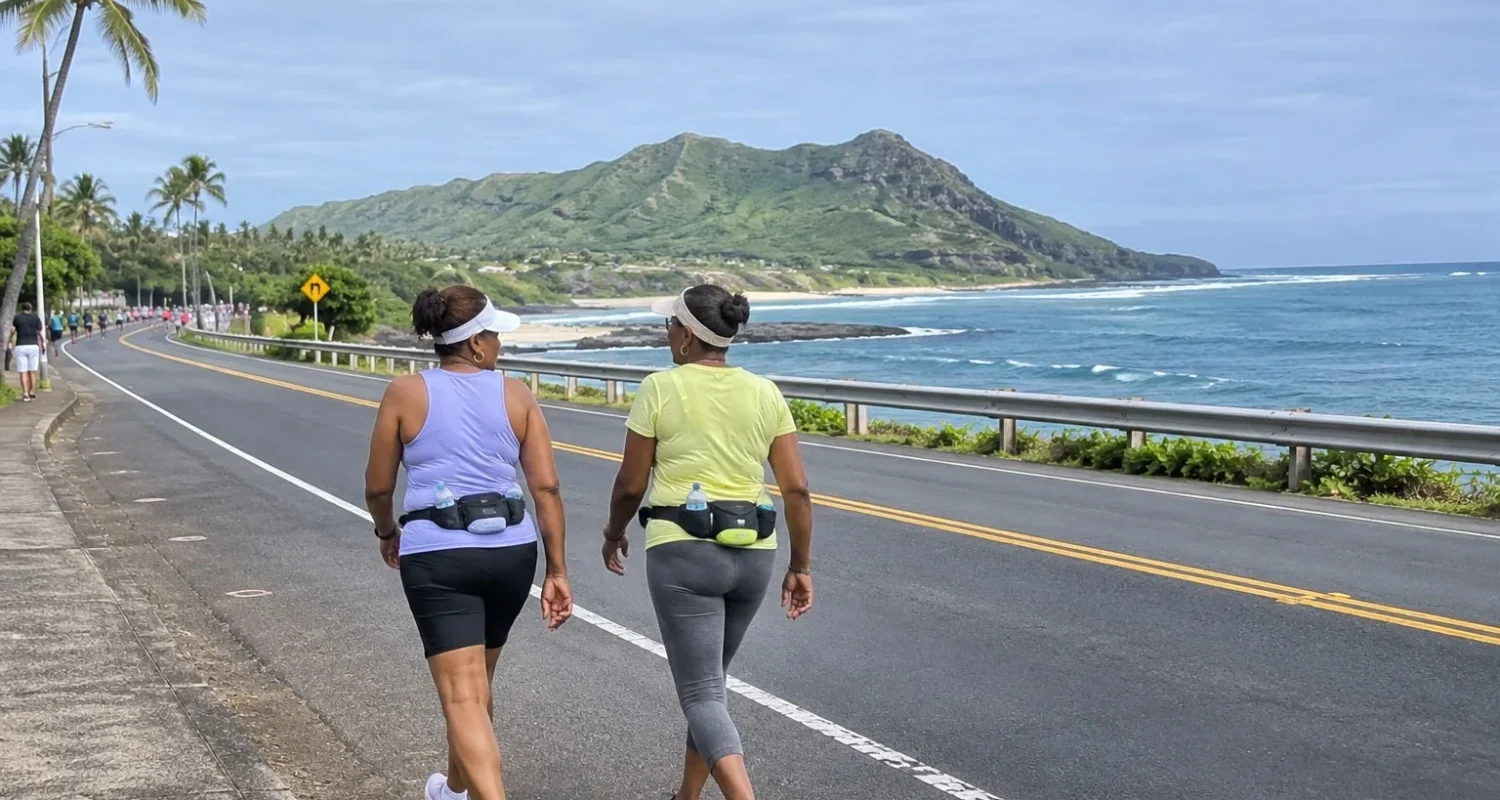
- Walk the climbs. The main hills are around Diamond Head, which the course passes twice: once early on Diamond Head Road, and again near the end on the ocean side past the lighthouse. Walking up them, even if you run elsewhere, keeps your effort even.
- Think in sections, not miles. The course breaks naturally into downtown, Waikiki, Diamond Head, the long Kalanianaʻole Highway stretch out to Hawaiʻi Kai and back, Kāhala, and the final climb. Ticking off sections is easier on the mind than counting 26 markers.
- Bank nothing. Trying to “build a cushion” before the heat rarely works the way people hope. A steady effort usually feels better at mile 20.
What happens when the sun comes up?
This is the turning point of a walker’s race. The official FAQ says race morning is often in the mid-60s °F (18 to 20 °C) and rises to the low 80s °F (27 to 28 °C) by mid-morning, humid and sunny. At most walking paces, you’ll spend four or more hours in that warmer part of the day.
What that means in practice:
- Dress for both halves. There’s no gear check at the start or on the course, so whatever you wear in the dark is what you’ll carry later. A light layer you don’t mind tying around your waist, or one you can hand to a supporter early on, works better than a jacket you’ll regret.
- Bring sun protection from the start. A hat or visor, sunglasses and sunscreen will matter far more at 10:00 a.m. than at 5:00 a.m. A small pocket or belt makes this easy.
- Don’t count on shade. Plan as if you’ll be in full sun from mid-morning on.
- Follow the medical staff. If they tell you to slow down or stop, do. The race goes ahead rain or shine, and officials may delay, modify or cancel it in dangerous conditions. For anything specific to your health, talk to your own doctor before you travel.
Traveling with family who aren’t walking? From Thursday 10 to Saturday 12 December, supporters can spend a day on the full circle island loop while you rest and collect your packet. Pickup is from six points in Waikiki between 6:50 and 7:15 a.m. Check dates and book the tour
What’s at the aid stations, and can you carry your own?
There are 16 aid stations with water, sports drinks and medical help. Precision Fuel & Hydration gels are available, and you’re allowed to carry your own supplies. Small hydration vests and belts are permitted.
For walkers, carrying a little of your own makes sense. You’ll be out longer than most of the field, and the official pages we checked don’t say how long each station stays staffed for the back of the race. If you expect to finish after midday, a small bottle or a few of your usual snacks gives you a buffer between stations. If you have questions about late-race support, the Expo in race week is a good place to ask, or email [email protected].
Phones and headphones are allowed, but stay aware of what’s around you, especially later in the morning when roads begin to reopen.
What’s still open when you finish late?
The most important thing is still open: the finish line. You’ll cross in Kapiʻolani Park, near the bandstand, and get your medal. The finisher village hands out a finisher shirt (you collect it after you finish, not at packet pickup), malasadas, bananas, water and recovery drinks.
Plan around a few clocks:
| Clock | Time | Why it matters for walkers |
|---|---|---|
| Start-line deadline | 5:30 a.m. | The only hard cutoff in the race |
| Sunrise | About 7:00 a.m. | Heat and sun build from here |
| Clothing tent deadline | 3:00 p.m. | Unclaimed bags at the Kapiʻolani Park clothing tent are donated |
| Sunset | About 5:51 p.m. | Plenty of daylight even for the longest finishes |
| Official results | Monday 14 Dec | Finisher Monday: official results, certificates, age-group awards |
That clothing tent deadline is the one that catches slower finishers. There’s a clothing-only check-in tent at Kapiʻolani Park, near the finish, and it only accepts the official bag from packet pickup. If you’re expecting a long day, ask yourself whether you’ll be back by 3:00 p.m. with time to spare. If not, give your extra clothes to a supporter instead. The official FAQ’s timing for the tent isn’t consistent, so check it in race week.
Your supporters can follow you live with “Track My Run” by bib number, and preliminary results go online on race day. That’s handy for working out when to head to the park.
Can you walk with a stroller, a dog or a wheelchair?
- Strollers: not allowed in the marathon. They’re only allowed in the Start to Park 10K, starting at the back.
- Pets: not allowed.
- Wheelchairs: allowed. Other wheeled devices are not.
If you’d like to walk with a young child in a stroller, the Start to Park 10K is the event built for that. It starts at 5:00 a.m. on the same morning, follows the first 10 km of the marathon course and finishes in Kapiʻolani Park.
A walker’s checklist for race week
- Collect your packet in person at the Hawaiʻi Convention Center between Thursday 10 and Saturday 12 December, with your confirmation and a valid photo ID.
- Note the start color on your bib and where your corral sits.
- Decide what you’re wearing at 5:00 a.m. and what you’re wearing at 11:00 a.m., and how you’ll carry the difference.
- Pack sun protection you can carry: hat or visor, sunglasses, sunscreen.
- Pack a small supply of your own food and drink if you expect to finish after midday.
- Agree a meeting point and a rough finish window with your supporters, and give them your bib number for tracking.
- Decide whether you’ll use the clothing tent, given the 3:00 p.m. deadline.
What should you do the day after?
Monday 14 December is Finisher Monday, with official results, certificates and age-group awards (top three in each group over 15, collected in person). After that, plenty of walkers like a day of sightseeing that doesn’t involve much walking.
Our full-day circle island tour is one way to do that. Be clear about what it is: about 9.5 hours, most of it spent riding between stops. Stops run 15 to 40 minutes, with a longer one at Turtle Beach (1 hour 15 minutes), and you decide how much you walk at each. We don’t claim it does anything for sore legs; it’s just a way to see the island from a seat. See how long a full-day Oahu tour takes and the full-day tour plan.
The first stop is the Diamond Head Lookout, on Diamond Head Road, the same road you walked up around the crater. The Standard tour is $59 per person with a free malasada and free snorkel gear, and the Promo Full-Day Loop is $49 with code FANTASY50 (the Leonard’s stop is included; the malasada is bought separately). There’s no runner discount. Our packing list for a full-day tour covers what to bring.
Please don’t plan a tour for race day itself. Roads on our route, including our Waikiki pickup area and Diamond Head Road, are closed that morning. If you’re considering Sunday 13 December, call us first on (808) 294-9906.
Good to know (checked November 2026)
The no-time-limit rule, the 5:30 a.m. start-line deadline and the medal for walkers are on the JAL Honolulu Marathon event page. Aid stations, the clothing tent and its 3:00 p.m. deadline, and stroller rules are in the official FAQs. Road reopening times above are from the 2025 Traffic Advisory; the 2026 version isn’t out yet. Sunrise and sunset are NOAA solar formula estimates. More race-week planning is in our Honolulu Marathon 2026 visitor guide.
FAQ
Can you walk the Honolulu Marathon?
Yes. There’s no time limit, the finish stays open until the last participant crosses, and walkers get a medal and an official time.
Is there a cutoff time at the Honolulu Marathon?
There’s no finish cutoff. The only deadline is at the start: everyone must cross the start line by 5:30 a.m.
How long does it take to walk the Honolulu Marathon?
At a steady 15 minutes per mile with no breaks, about 6.5 hours; at 20 minutes per mile, about 8.75 hours. Breaks count toward your chip time, so most walkers take longer.
Do walkers get a medal at the Honolulu Marathon?
Yes. Walkers get the same finisher medal and official time as runners, plus the finisher shirt and the food and drinks in the finisher village.
Can you bring a stroller to the Honolulu Marathon?
Not in the marathon. Strollers are only allowed in the Start to Park 10K, starting at the back.
Should walkers carry their own water at the Honolulu Marathon?
There are 16 aid stations with water and sports drinks, and you may carry your own supplies. Walkers who expect to finish after midday often carry a small extra supply as a buffer.
Walk it your way
No cutoff means the Honolulu Marathon is one of the few big-city marathons where you can walk every step and still be a finisher. Respect the 5:30 a.m. start, plan for the sun after 7:00 a.m., and keep an eye on that 3:00 p.m. clothing tent deadline.
See the island from a seat after your walk. From Monday 14 December, ride the full loop around Oahu, starting at the Diamond Head Lookout on the road you walked. Check dates and book the tour
Aloha Fantasy Tours has run circle island tours on Oahu since 2010. We are not affiliated with the JAL Honolulu Marathon.
Photo credits: Anthony Quintano from Honolulu, HI, United States, CC BY 2.0. Race photos are from past Honolulu Marathons.