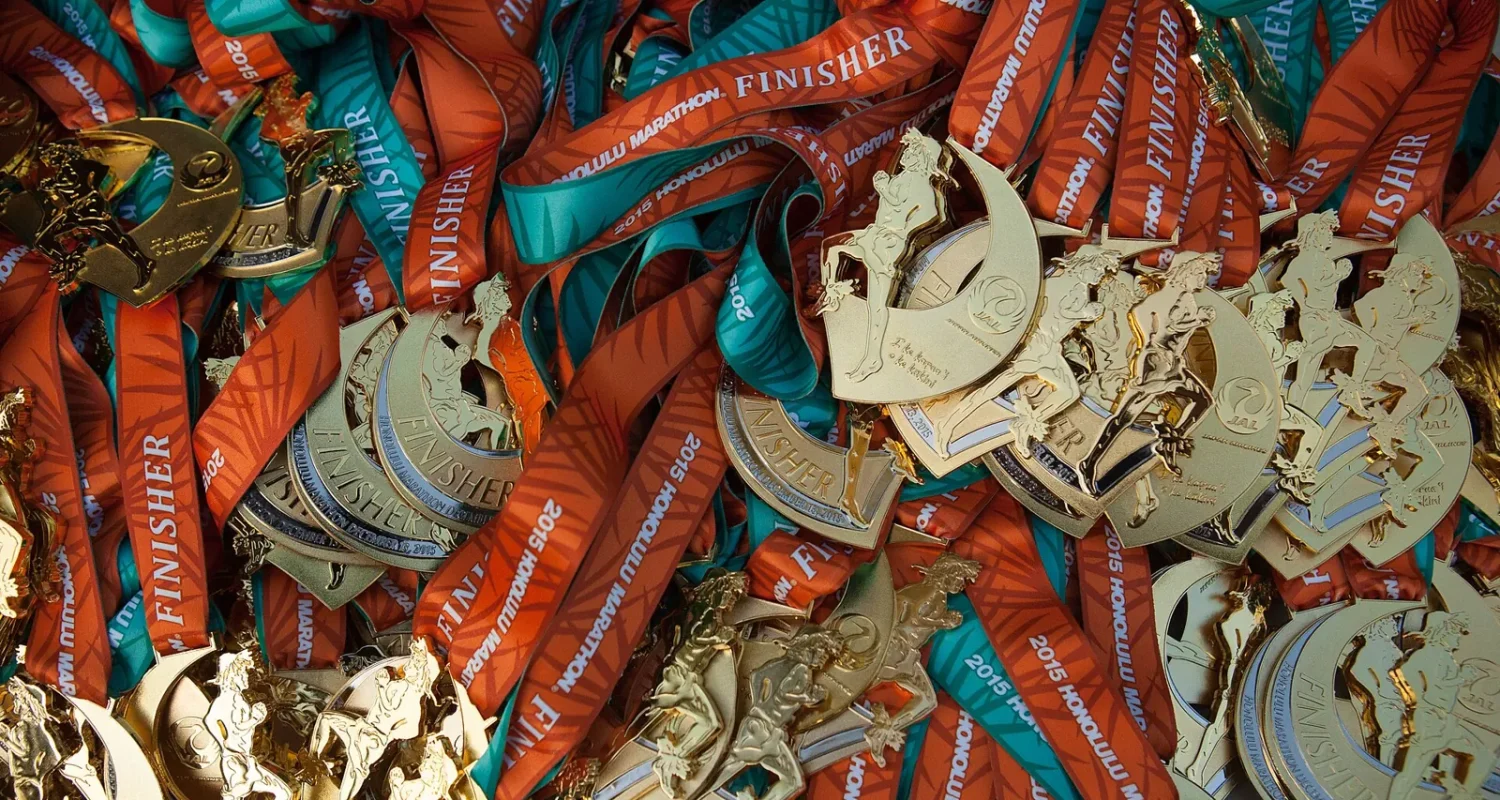
The Honolulu Marathon is a 26.2-mile race on Sunday 13 December 2026 that starts at 5:00 a.m., in the dark, with fireworks on Ala Moana Boulevard and finishes in Kapiʻolani Park in Waikiki. There’s no time limit, no qualifying time and no lottery, so first-timers of any pace are welcome. Expect a big crowd, no gear check at the start, two climbs around Diamond Head, and heat building after sunrise at about 7:00 a.m. At the finish you get a medal, a finisher shirt and malasadas.
That’s the short version. Here’s what the day actually feels like, and what tends to catch first-timers off guard.
Is the Honolulu Marathon a good first marathon?
For a lot of people, yes, and the main reason is simple: nobody will pull you off the course for being slow. The official event page says the finish stays open until the last participant crosses, and walkers get a medal and an official time just like everyone else. That takes away the biggest worry most first-timers carry into a big-city marathon.
Getting in is easy, too. There’s no qualifying time and no lottery. The event page says the race is open to anyone over seven years old, and online registration stays open until 3 December 2026.
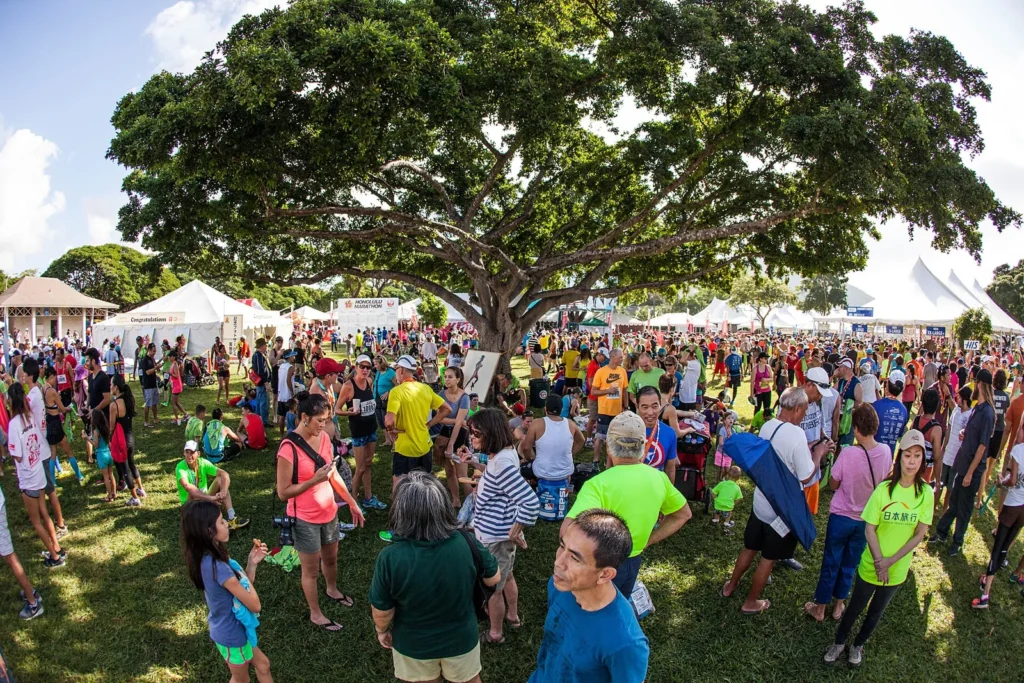
It’s also a big, friendly event. Organizers describe it as having “over 35,000 runners”, and the official FAQ talks about close to 40,000 participants at the start across the race morning. Visitors from Japan have made up the majority of entrants in many years (Japan Airlines has been the title sponsor since 1985, and organizers keep an office in Tokyo), so you’ll hear a lot of Japanese around you, see a lot of costumes and feel a real holiday mood.
Two honest caveats. First, it isn’t a flat course: Wikipedia describes it as relatively hilly for a marathon, with the main climbs around Diamond Head, which you pass twice. Second, it gets warm. The official FAQ says race morning is often in the mid-60s °F (18 to 20 °C) and rises to the low 80s °F (27 to 28 °C) by mid-morning, humid and sunny. Neither is a reason to skip it. Both are reasons to pace yourself and keep your goals kind.
What does race day look like, from alarm to medal?
Here’s the shape of the day. The times for the start and sunrise are official or calculated; everything else depends on your pace.
| Time (Sunday 13 Dec) | What’s happening | What it means for you |
|---|---|---|
| 2:00 to 4:00 a.m. | Free shuttles run from the Honolulu Zoo to the start | Your alarm time depends on how you get to the start |
| Before 5:00 a.m. | Runners fill the start on Ala Moana Boulevard near Ala Moana Beach Park | Find the start color printed on your bib |
| 5:00 a.m. | Fireworks, and the race begins | It’s fully dark |
| By 5:30 a.m. | Everyone must have crossed the start line | Back of the pack may take a while to reach the line |
| About 7:00 a.m. | Sunrise | The first two hours are run in the dark |
| Mid-morning | Temperatures rise toward the low 80s °F | Sun and humidity matter most now |
| Your finish | Kapiʻolani Park, near the bandstand | Medal, then the finisher village |
| Monday 14 Dec | Finisher Monday | Official results, certificates and age-group awards |
The early hours are the part people underestimate: you’re up in the middle of the night and standing in a dark crowd for a while before anything happens. It passes quickly once the fireworks go up.
What surprises first-timers most?
The start is in the middle of the night
A 5:00 a.m. start means a wake-up that feels more like a late night. There’s no official parking at the start or the finish, and many roads are closed, so organizers recommend walking from Waikiki, getting dropped off, carpooling or using rideshare, or taking the free shuttle from the Honolulu Zoo between 2:00 and 4:00 a.m. The race doesn’t run hotel shuttles. Board early rather than late.
Fireworks, then a slow shuffle
The race opens with fireworks, and with tens of thousands of people lined up, reaching the line can take a while toward the back. Everyone must cross by 5:30 a.m. Your start position is based on the predicted finish time you gave at registration, and the color is printed on your bib. Your chip time only starts when you cross the line, so there’s no need to push through the crowd.
There’s no gear check at the start
This one catches people every year. There is no gear check at the start or on the course. If you bring a jacket, you’ll either carry it, tie it on, or hand it to a supporter. There is a clothing-only check-in tent at Kapiʻolani Park, near the finish, but only the official bag from packet pickup is accepted, and the official FAQ’s timing for that tent isn’t consistent, so check the FAQ in race week for its hours. Unclaimed bags after 3:00 p.m. on race day are donated.
Diamond Head comes twice
After the downtown and Waikiki section, the course turns up Diamond Head Road and climbs around the crater, the 760-foot extinct volcano that stands over Waikiki. Much later, after the long out-and-back to Hawaiʻi Kai and the loop through Kāhala, you come back over Diamond Head Road on the ocean side, past the Diamond Head Lighthouse, before dropping onto Kalākaua Avenue for the finish. That second climb comes when your legs are tired, so save something for it.
The heat arrives after sunrise
The first two hours are cool and dark. Then the sun comes up at about 7:00 a.m. and the temperature climbs, with high humidity. If you’re out there for five, six or seven hours, the second half of your race is in full sun. Plan for that.
Nobody sweeps you off the course
With no time limit, there’s no finish cutoff to chase. That’s a gift, but it also means it’s on you to manage your effort, drink, and take breaks when you need them. Your chip time is total elapsed time, including any breaks.
Bringing family who won’t be running? Thursday 10 to Saturday 12 December is a good window for supporters to see the whole island while the runner rests and picks up their packet. Our full-day tour picks up at six points in Waikiki between 6:50 and 7:15 a.m. Check dates and book the tour
What’s included with your entry?
Your entry covers a lot more than a bib. Here’s what the official pages list.
- A bib with an embedded timing chip, collected in person at the Expo with your registration confirmation and a valid photo ID. Packets aren’t mailed and aren’t handed out on race day.
- 16 aid stations with water, sports drinks and medical help. Precision Fuel & Hydration gels are available, and you may carry your own supplies.
- Official pacers from 3 hours to 5 hours.
- Portable restrooms at the start, along the course and at the finish.
- Live tracking by bib number on race day (“Track My Run”), so people at home can follow you.
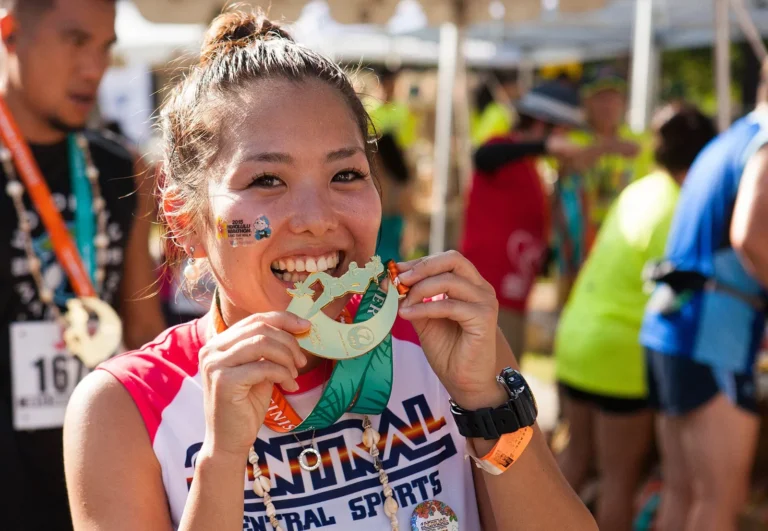
- The finisher village: your medal, a finisher shirt (handed out after you finish), malasadas, bananas, water and recovery drinks.
- Results and certificates: preliminary results online on race day, official results from Finisher Monday (14 December), and certificates on Finisher Monday or as a download.
- Age-group awards for the top three in each group over 15, collected in person on Finisher Monday.
How much does it cost, and is it too late to enter?
It isn’t too late. Online registration closes on 3 December 2026, and after that you can still enter at the Expo, at a higher price. There is no race-day sign-up.
| Category | 13 Oct to 3 Dec (online) | At the Expo |
|---|---|---|
| Marathon, Hawaiʻi residents | $255 | $460 |
| Marathon, USA and Canada residents | $255 | $460 |
| Marathon, US active-duty military and students | 10% off | $360 |
| Marathon, international | $320 | $460 |
| Start to Park 10K | $130 | $160 |
| Kalākaua Merrie Mile | $70 | $80 |
A few more details from the official fee page:
- Groups of 5 or more entries get 10% off, and 10 or more get 15% off.
- There’s a pay-monthly option in three payments through Let’s Do This.
- Distance changes and transfers between registrations close on 13 November 2026. Transferring your entry to another person already closed on 1 November.
- Entries are generally non-refundable and non-deferrable unless you bought booking protection.
What happens in the days before the race?
The Expo and packet pickup run at the Hawaiʻi Convention Center, 1801 Kalākaua Avenue, from Thursday 10 to Saturday 12 December, in person only.
On Saturday 12 December at 7:00 a.m., the one-mile Kalākaua Merrie Mile runs through Waikiki. Downtown, the Honolulu City Lights display by Honolulu Hale is on all month, and the marathon passes it early in the race, still in the dark.
Many first-timers arrive a few days early to get over the flight and the time change. If this is also your first trip to the island, our first-time Oahu guide and our notes on getting around Oahu without a car cover the basics.
What can you bring and wear on the course?
The official FAQ is relaxed about most things, with a few firm rules.
Allowed
- Phones and headphones (stay aware of what’s around you)
- Costumes, as long as they don’t endanger you or others or make you overheat
- Small hydration vests or belts
- Wheelchairs
Not allowed
- Strollers (they’re only allowed in the Start to Park 10K, starting at the back)
- Pets
- Wheeled devices other than wheelchairs
Running shoes are strongly recommended, although barefoot and sandals are permitted. On race morning, whatever you wear to the start is what you run in, or what you hand to someone, because of the no-gear-check rule.
How should a first-timer think about the heat?
We’re a tour company, not a running coach or a doctor, so take this as general, widely shared guidance rather than medical advice.
- Use the cool hours wisely. The dark first two hours feel easy. Going out too fast there is the classic mistake.
- Drink at the aid stations. There are 16 of them with water and sports drinks, plus medical help.
- Cover up for the sun. A hat or visor, sunglasses for later, and sunscreen make sense for a race that runs into full sun.
- Listen to the medical staff. If they tell you to stop, stop. The official FAQ also says the race goes ahead rain or shine, but officials may delay, modify or cancel it in dangerous conditions.
- Talk to your own doctor about racing in heat, especially if you have a health condition.
What happens after you cross the finish line?
You’ll finish in Kapiʻolani Park, near the bandstand, with Diamond Head behind you. Then it’s the finisher village: medal, shirt, a malasada (a Portuguese-style doughnut that’s a local favorite), bananas, water and recovery drinks. If you used the clothing check-in tent, collect your bag well before 3:00 p.m.
Roads around the course reopen progressively through the day, so Sunday afternoon is for a slow meal and an early night. The next morning is Finisher Monday, when official results go up and certificates are available.
Seeing the island once your race is done
From Monday 14 December onward, a full-day circle island tour is a way to see Oahu mostly from a seat. Be clear about what it is: about 9.5 hours, most of it riding between stops, with stops of 15 to 40 minutes and a longer one at Turtle Beach (1 hour 15 minutes). You choose how much you walk at each one.
Two stops feel personal after this race. Our first stop is the Diamond Head Lookout on Diamond Head Road, the same road you climbed around the crater, so you can look at it again from the window and the lookout without running it. And our third stop is Leonard’s Bakery, home of the malasadas you may have tasted at the finish line. Read more about the malasada and food stops, or see the full day plan for the circle island tour.
The Standard tour is $59 per person and includes a free malasada and free snorkel gear. The Promo Full-Day Loop is $49 with code FANTASY50; it still stops at Leonard’s, and the malasada is bought separately there. There’s no runner discount. Pickup is from six fixed points in Waikiki; see where the tour picks you up.
The Diamond Head stop is a 15-minute lookout, not the summit hike. If you want to hike the crater later in your trip, our Diamond Head guide explains reservations and timing.
A note about race day itself
Please don’t plan a tour for Sunday 13 December. Our pickup points and the first part of our route, including Ala Moana Boulevard, Kalākaua Avenue and Diamond Head Road, sit inside the race-day road closures that morning. If you’re thinking about that day, call us first on (808) 294-9906.
Good to know (checked November 2026)
Race date, 5:00 a.m. start, 5:30 a.m. start-line deadline and the no-time-limit rule come from the JAL Honolulu Marathon event page. Gear check, clothing tent times and what’s allowed on course are in the official FAQs, which can change in race week. Fees and deadlines are on the How to Enter page. Sunrise of about 7:00 a.m. is calculated from the NOAA solar formula. Aloha Fantasy Tours is not affiliated with the race. For everything in one place, see our Honolulu Marathon 2026 visitor guide.
FAQ
Is there a time limit at the Honolulu Marathon?
No. The finish stays open until the last participant crosses, and walkers get a medal and an official time. You do need to cross the start line by 5:30 a.m.
What time does the Honolulu Marathon start?
The marathon starts at 5:00 a.m. on Sunday 13 December 2026, with fireworks, on Ala Moana Boulevard near Ala Moana Beach Park. The first two hours are run in the dark.
Is there a gear check at the Honolulu Marathon?
There’s no gear check at the start or on the course. There is a clothing-only check-in tent at Kapiʻolani Park that accepts only the official bag from packet pickup; check the official FAQ for its hours.
Do you need a qualifying time to run the Honolulu Marathon?
No. There’s no qualifying time and no lottery. The event page says it’s open to anyone over seven years old.
What do you get at the Honolulu Marathon finish?
A medal, a finisher shirt handed out after you finish, malasadas, bananas, water and recovery drinks. Official results and certificates follow on Finisher Monday, 14 December.
Is the Honolulu Marathon course hilly?
It’s considered relatively hilly for a marathon. The main climbs are around Diamond Head, which the course passes twice, once early and once near the finish.
Ready for your first Honolulu Marathon?
Go in knowing the shape of the day: a middle-of-the-night alarm, fireworks in the dark, Diamond Head twice, a hot second half and a malasada at the end. Pace for the heat and enjoy the crowd.
See the whole island after your race. From Monday 14 December, ride the full circle island loop, starting at the Diamond Head Lookout on the course you just ran. Check dates and book the tour
Aloha Fantasy Tours has run circle island tours on Oahu since 2010. We are not affiliated with the JAL Honolulu Marathon.
Photo credits: Anthony Quintano from Honolulu, HI, United States, CC BY 2.0; Anthony Quintano from Honolulu, HI, United States, CC BY 2.0. Race photos are from past Honolulu Marathons.